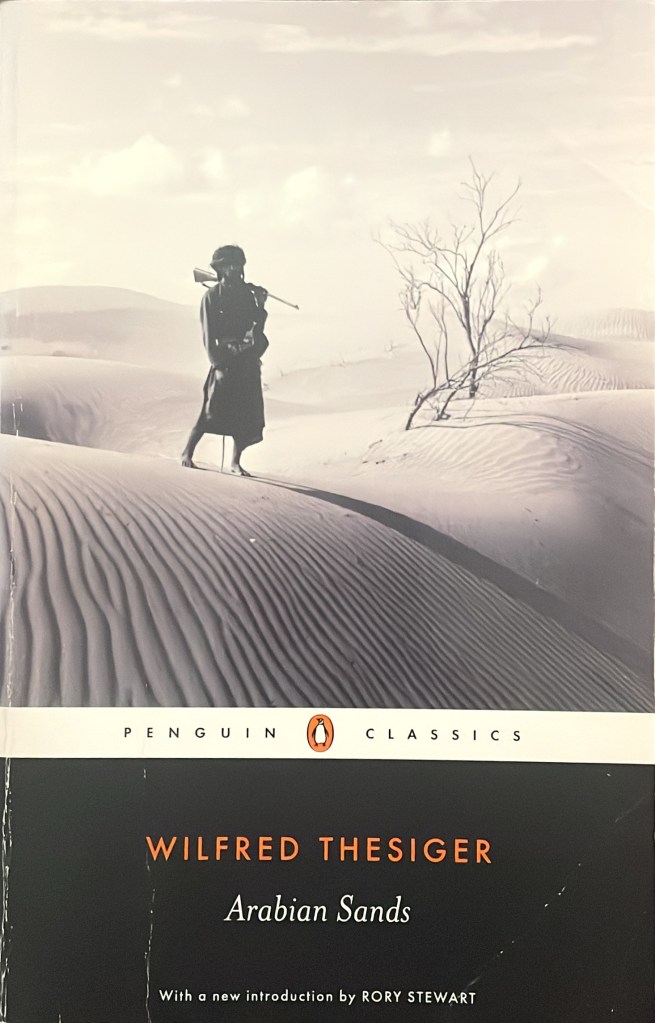
In the second half of the 1940s, the British explorer and adventurer Wilfred Thesiger went to Arabia to travel through the „Empty Quarter“ (Rub‘ Al Khali), one of the most desolate and hostile desert regions of the world. His book „Arabian Sands“ is the account of the two journeys he made with a handful of Bedouin guides.
Ironically, there is one passage in the book in which Thesiger ponders on the lack of privacy in the desert. Whenever he wandered off from the group, if only to satisfy a human need, one or two of his companions would soon show up to see what he was doing.
As a highly sociable people they liked company, noise, excitement and could just not grasp the idea that a human being would want to be alone once in a while.
They also could not understand his urge to go to a place that the Bedouins would seek to avoid, as natural conditions were extreme and there was no food for their animals.
These two passages point to the paradox and dilemma of people who go to strange and wild places to escape Western civilisation: they might find that the inhabitants of these regions value just the things they want to escape from.
Thesiger was also a keen photographer. Together with his descriptions of Bedouin life and culture, the images in his book recreate a world that had not changed for many centuries but was to disappear once and for all with the oil boom of the 1950s and 1960s, a development that Thesiger deeply regretted. One photo in the book shows Abu Dhabi – at the time not more than an obscure fishing harbour.
Thesiger’s impressive photo collection is now at the Pitt Rivers Museum in Oxford.
 Steiner's Digest
Hinterlasse einen Kommentar